SportsInjuryTreatment
Thekneethat'gaveway'onthefielddeservesmorethanrestandacrepebandage.
It usually happens in a split second. A footballer plants his foot and turns, feels a pop inside the knee, and is helped off the ground. A badminton player lunges and her ankle rolls. A gym-goer feels something tear in his shoulder mid-lift. What happens in the following two weeks — not the injury itself — often decides whether they return to sport or join the crowd of people whose knee 'has never been the same since'.
The most common mistake we see in Jabalpur is the injury that was never diagnosed. The swelling went down with rest and a bandage, so everyone assumed it healed. But an ACL doesn't reattach itself, and a torn meniscus doesn't fill back in — the knee works fine on straight-line walking and then betrays you on the first twist. Six months later the patient arrives with a knee that buckles unpredictably, and sometimes with new cartilage damage caused by all those small givings-way.
Sports injury care at Patle Health Care Center starts with a precise answer to one question: exactly which structure is damaged, and how badly? From there the advice is honest. Not every ACL tear needs reconstruction. Not every meniscus tear needs an operation. But every significant injury needs a decision made with full information — and a rehabilitation plan that ends with your knee trusted again, not just quiet.
Injury Patterns Worth Taking Seriously
- A 'pop' felt or heard in the knee during a twist, with swelling within a few hours — the classic ACL story
- A knee that locks, catches, or clicks painfully — often a meniscus tear mechanically blocking the joint
- A knee or ankle that keeps 'giving way' months after an old injury
- An ankle that has been sprained three, four, five times — recurrent sprains mean the ligaments never regained stability
- Shoulder pain with overhead activity, or a shoulder that has dislocated even once
- Any sporting injury where you're unsure whether to play again — checking costs one OPD visit; playing on a damaged joint can cost a season or a career
How We Approach Sports Injuries
Structure-by-Structure Diagnosis
Specific clinical tests for each ligament and meniscus, X-ray in-house to rule out bony injury, and MRI advised when it will genuinely change the decision — not as a reflex.
Honest Surgery Advice
A desk worker with a partial tear and a stable knee gets a different recommendation than a 22-year-old district-level footballer with a complete ACL rupture. The advice fits your injury and your life, and both options are explained with their real trade-offs.
Meniscus-Preserving Philosophy
The meniscus is the knee's shock absorber, and removing it carelessly buys arthritis a decade early. Where the tear pattern allows, treatment aims to preserve or respect it rather than sacrifice it.
Rehab That Ends at 'Match-Fit', Not 'Pain-Free'
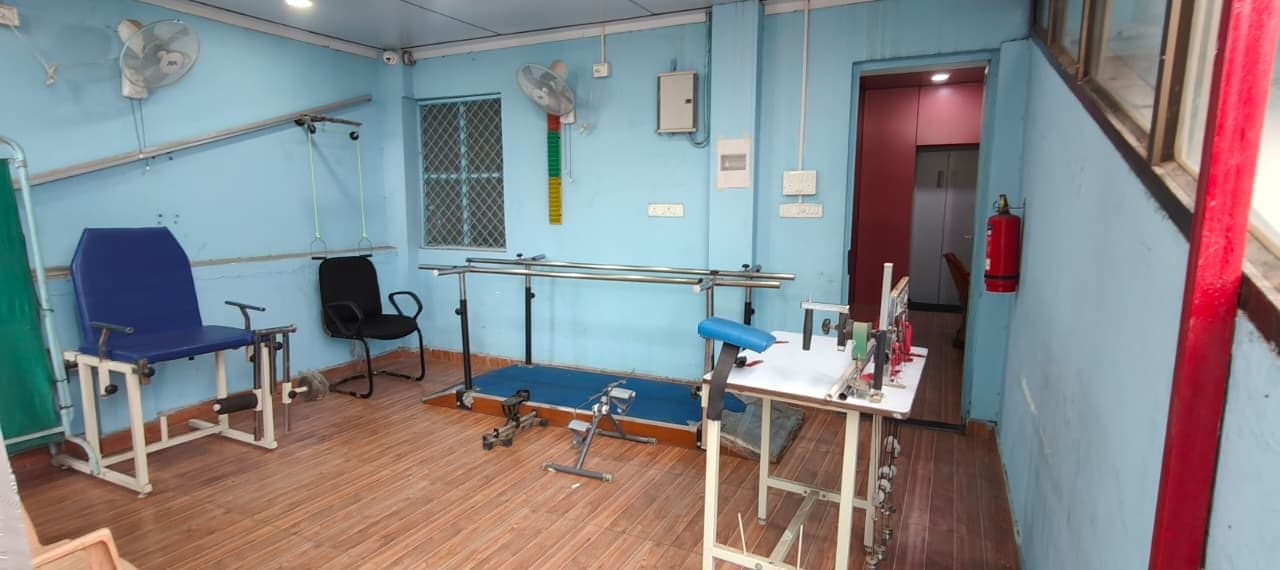
At our in-house physiotherapy centre, return to sport is earned through stages — range, strength, balance, sport-specific movement — with progression decided by what your leg can do, not by dates on a calendar.
Recovery & What to Expect
Recovery time depends entirely on the injury: a first ankle sprain may need three focused weeks; an ACL reconstruction is a several-month project where the surgery is honestly the easy part. The number that matters more than weeks is strength symmetry — how close the injured leg is to the healthy one. Returning before roughly nine-tenths symmetry is how re-injuries happen, and we'll tell you plainly when you're there and when you're not.
Frequently Asked Questions
I heard a pop in my knee but I can walk fine now. Do I still need to get it checked?
Yes — and this exact situation is why. A completely torn ACL often allows comfortable straight-line walking once swelling settles; the instability only shows up on turning, pivoting, or uneven ground. Walking normally tells you very little about ligament status. A clinical examination settles the question quickly, and catching it now prevents the cartilage damage that repeated giving-way causes later.
Can an ACL tear heal with rest and exercise alone?
A fully torn ACL does not grow back together — that's biology, not opinion. What rehabilitation can do is train the muscles around the knee to compensate, which works well for people with partial tears or less rotationally demanding lives. For those who play pivoting sports or have knees that give way despite good rehab, reconstruction is the reliable option. Which camp you fall into is exactly what the consultation determines.
How soon after injury should I come in?
Ideally within the first few days. Early on we can settle swelling correctly, splint if needed, and plan examination when the knee allows it. But late is genuinely better than never — even injuries from years ago can be assessed and usually improved, whether by rehabilitation or surgery.
Do you only treat athletes?
Not at all. The same ligaments tear on a wet bathroom floor as on a football field, and the same careful diagnosis applies. Homemakers, students, farmers, office workers — anyone with a joint injury gets the same structure-by-structure assessment. 'Sports medicine' describes the method, not a membership requirement.
Will I definitely need an MRI?
Not necessarily. Clinical examination diagnoses most significant ligament and meniscus injuries reliably, and the in-house X-ray rules out fractures immediately. MRI is advised when surgery is being considered or when the examination leaves a genuine question — in other words, when its result would change what we do, not as a default expense.